Case Study
Automating candidate verification so recruiters can focus on placing people, not chasing paperwork
THE PROBLEM
Manual checks in high-volume placement firms cause significant bottlenecks
Every candidate placed needs to pass verification before they start: ID checks, right-to-work documentation, and certifications. For a temp recruitment agency placing dozens of candidates a week, that is an enormous amount of repetitive checking, cross-referencing, and chasing.
Onboarding coordinators were spending the majority of their time in a loop: check what’s been submitted, identify what’s missing, follow up with the candidate, wait, check again. Conducting 400 checks per month, over 5 000 a year, the work wasn’t complex, but it was time-consuming, and it sat entirely on a human’s plate.
The knock-on effect was direct. Candidates sitting in the verification queue weren’t starting. Placements were delayed. Revenue that should have been landing was waiting on someone to manually move a document through a checklist. At volume, this creates a huge bottleneck.
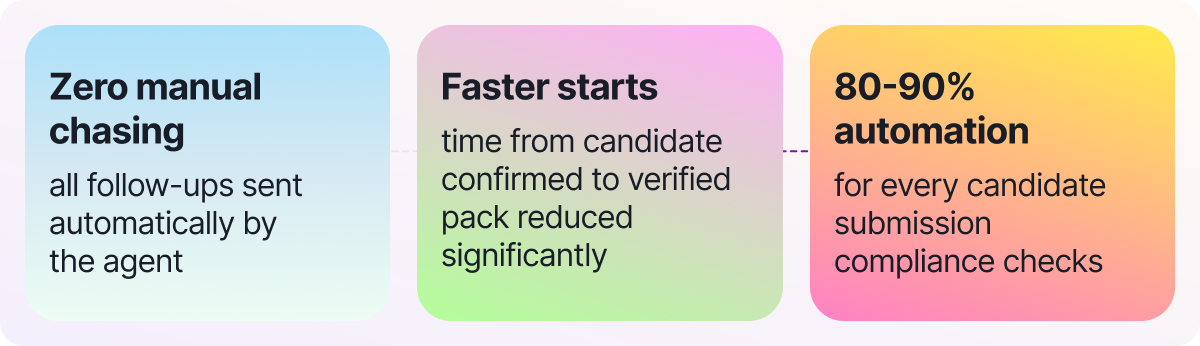
The problem wasn’t a lack of process. There was a clear checklist. The problem was that executing it required a lot of human intervention, where 80-90% could be automated.
THE WORKFLOW
Verification that runs itself
When a candidate is confirmed for placement, the Rightbrain-powered pipeline initiates automatically. The agent works through the verification checklist, tracks what’s been submitted, follows up on gaps, and compiles the completed pack. The coordinator steps in at the end to review and approve, not at every step along the way, which frees up their time to work on more complex cases.
THE VERIFICATION PIPELINE
Candidate confirmed → verified onboarding pack
When a candidate is confirmed for placement, their details enter the onboarding workflow automatically. The Rightbrain agent initiates the verification checklist: what documents are required, what checks need to be completed, and what is already on file from previous placements or prior submissions.
As documents come in, the agent cross-references each one against requirements - checking for expiry dates, inconsistencies, missing fields, and compliance gaps. Anything that doesn’t pass is flagged immediately, with an automated follow-up sent directly to the candidate detailing exactly what is needed.
The agent tracks the status of every open item across every candidate in the pipeline simultaneously. Nothing waits in a queue because someone hasn’t had time to look at it yet.
Once all checks pass, the agent compiles a verified onboarding pack and routes it to the coordinator for final sign-off. The human reviews a completed file, not a half-finished checklist.
Workflow:

The coordinator’s role shifts from manually pushing the process through, to overseeing the process and signing off on the outcome - acting as a higher-level supervisor. The agent handles the chasing, checking, and compiling. The human makes the final call.
WHAT CHANGED
Coordinators now have time to focus on more complex tasks
✓ Coordinators are no longer the bottleneck. The repetitive loop of check, chase, wait, check again is handled by the agent. Their time goes to the exceptions that need human judgement: a reference that doesn’t add up, a candidate with unusual circumstances, a compliance edge case that needs a decision.
✓ Every candidate goes through the same checks every time. No variation based on who is handling the file or how busy the team is. Compliance coverage is consistent at scale.
✓ Candidates are onboarded faster. Nothing sits in a queue waiting for a manual review. Follow-ups go out immediately when something is missing, not when someone gets around to noticing.
✓ Placements start sooner. The time between “candidate accepted” and “candidate starts” is shorter because verification no longer depends on coordinator availability.
✓ The pipeline scales without adding headcount. Doubling placement volume doesn’t mean doubling the onboarding team. The agent handles the increase; the coordinator capacity stays focused on quality and exceptions.
WHO THIS IS FOR
Any recruitment business where "candidate accepted" and "candidate starts" is longer than it should be.
This workflow applies to any business placing candidates at volume, where the manual verification creates significant bottlenecks.
It’s particularly effective where compliance requirements are consistent across placements - the same checks, the same documents, the same standards applied to every candidate. When the process is defined but the execution is manual, there’s a strong case for automation.
The workflow runs inside the tools the team already uses. There is no new platform to manage, no new login for coordinators to remember. The agent operates in the background, surfacing only what needs a human decision.
How else are recruitment agencies using Rightbrain?
With Rightbrain, it’s all about stacking different agents on your way to becoming AI-native. Here’s some other agents recruitment agencies have been building:
- CRM enrichment: All new leads are automatically enriched to provide context for marketing and sales
See this running in your stack
We’ll map your current onboarding workflow and build the agent with you.

Ready to ship your next AI feature?
Book demo




Case Study
Automating candidate verification so recruiters can focus on placing people, not chasing paperwork
THE PROBLEM
Manual checks in high-volume placement firms cause significant bottlenecks
Every candidate placed needs to pass verification before they start: ID checks, right-to-work documentation, and certifications. For a temp recruitment agency placing dozens of candidates a week, that is an enormous amount of repetitive checking, cross-referencing, and chasing.
Onboarding coordinators were spending the majority of their time in a loop: check what’s been submitted, identify what’s missing, follow up with the candidate, wait, check again. Conducting 400 checks per month, over 5 000 a year, the work wasn’t complex, but it was time-consuming, and it sat entirely on a human’s plate.
The knock-on effect was direct. Candidates sitting in the verification queue weren’t starting. Placements were delayed. Revenue that should have been landing was waiting on someone to manually move a document through a checklist. At volume, this creates a huge bottleneck.
The problem wasn’t a lack of process. There was a clear checklist. The problem was that executing it required a lot of human intervention, where 80-90% could be automated.
THE WORKFLOW
Verification that runs itself
When a candidate is confirmed for placement, the Rightbrain-powered pipeline initiates automatically. The agent works through the verification checklist, tracks what’s been submitted, follows up on gaps, and compiles the completed pack. The coordinator steps in at the end to review and approve, not at every step along the way, which frees up their time to work on more complex cases.
THE VERIFICATION PIPELINE
Candidate confirmed → verified onboarding pack
When a candidate is confirmed for placement, their details enter the onboarding workflow automatically. The Rightbrain agent initiates the verification checklist: what documents are required, what checks need to be completed, and what is already on file from previous placements or prior submissions.
As documents come in, the agent cross-references each one against requirements - checking for expiry dates, inconsistencies, missing fields, and compliance gaps. Anything that doesn’t pass is flagged immediately, with an automated follow-up sent directly to the candidate detailing exactly what is needed.
The agent tracks the status of every open item across every candidate in the pipeline simultaneously. Nothing waits in a queue because someone hasn’t had time to look at it yet.
Once all checks pass, the agent compiles a verified onboarding pack and routes it to the coordinator for final sign-off. The human reviews a completed file, not a half-finished checklist.
Workflow:
The coordinator’s role shifts from manually pushing the process through, to overseeing the process and signing off on the outcome - acting as a higher-level supervisor. The agent handles the chasing, checking, and compiling. The human makes the final call.
WHAT CHANGED
Coordinators now have time to focus on more complex tasks
✓ Coordinators are no longer the bottleneck. The repetitive loop of check, chase, wait, check again is handled by the agent. Their time goes to the exceptions that need human judgement: a reference that doesn’t add up, a candidate with unusual circumstances, a compliance edge case that needs a decision.
✓ Every candidate goes through the same checks every time. No variation based on who is handling the file or how busy the team is. Compliance coverage is consistent at scale.
✓ Candidates are onboarded faster. Nothing sits in a queue waiting for a manual review. Follow-ups go out immediately when something is missing, not when someone gets around to noticing.
✓ Placements start sooner. The time between “candidate accepted” and “candidate starts” is shorter because verification no longer depends on coordinator availability.
✓ The pipeline scales without adding headcount. Doubling placement volume doesn’t mean doubling the onboarding team. The agent handles the increase; the coordinator capacity stays focused on quality and exceptions.
WHO THIS IS FOR
Any recruitment business where "candidate accepted" and "candidate starts" is longer than it should be.
This workflow applies to any business placing candidates at volume, where the manual verification creates significant bottlenecks.
It’s particularly effective where compliance requirements are consistent across placements - the same checks, the same documents, the same standards applied to every candidate. When the process is defined but the execution is manual, there’s a strong case for automation.
The workflow runs inside the tools the team already uses. There is no new platform to manage, no new login for coordinators to remember. The agent operates in the background, surfacing only what needs a human decision.
How else are recruitment agencies using Rightbrain?
With Rightbrain, it’s all about stacking different agents on your way to becoming AI-native. Here’s some other agents recruitment agencies have been building:
- CRM enrichment: All new leads are automatically enriched to provide context for marketing and sales
See this running in your stack
We’ll map your current onboarding workflow and build the agent with you.
Ready to ship your next AI feature?
Book demo

Resources
Docs

Book a Call
Case Study
Automating candidate verification so recruiters can focus on placing people, not chasing paperwork
THE PROBLEM
Manual checks in high-volume placement firms cause significant bottlenecks
Every candidate placed needs to pass verification before they start: ID checks, right-to-work documentation, and certifications. For a temp recruitment agency placing dozens of candidates a week, that is an enormous amount of repetitive checking, cross-referencing, and chasing.
Onboarding coordinators were spending the majority of their time in a loop: check what’s been submitted, identify what’s missing, follow up with the candidate, wait, check again. Conducting 400 checks per month, over 5 000 a year, the work wasn’t complex, but it was time-consuming, and it sat entirely on a human’s plate.
The knock-on effect was direct. Candidates sitting in the verification queue weren’t starting. Placements were delayed. Revenue that should have been landing was waiting on someone to manually move a document through a checklist. At volume, this creates a huge bottleneck.
The problem wasn’t a lack of process. There was a clear checklist. The problem was that executing it required a lot of human intervention, where 80-90% could be automated.
THE WORKFLOW
Verification that runs itself
When a candidate is confirmed for placement, the Rightbrain-powered pipeline initiates automatically. The agent works through the verification checklist, tracks what’s been submitted, follows up on gaps, and compiles the completed pack. The coordinator steps in at the end to review and approve, not at every step along the way, which frees up their time to work on more complex cases.
THE VERIFICATION PIPELINE
Candidate confirmed → verified onboarding pack
When a candidate is confirmed for placement, their details enter the onboarding workflow automatically. The Rightbrain agent initiates the verification checklist: what documents are required, what checks need to be completed, and what is already on file from previous placements or prior submissions.
As documents come in, the agent cross-references each one against requirements - checking for expiry dates, inconsistencies, missing fields, and compliance gaps. Anything that doesn’t pass is flagged immediately, with an automated follow-up sent directly to the candidate detailing exactly what is needed.
The agent tracks the status of every open item across every candidate in the pipeline simultaneously. Nothing waits in a queue because someone hasn’t had time to look at it yet.
Once all checks pass, the agent compiles a verified onboarding pack and routes it to the coordinator for final sign-off. The human reviews a completed file, not a half-finished checklist.
Workflow:
The coordinator’s role shifts from manually pushing the process through, to overseeing the process and signing off on the outcome - acting as a higher-level supervisor. The agent handles the chasing, checking, and compiling. The human makes the final call.
WHAT CHANGED
Coordinators now have time to focus on more complex tasks
✓ Coordinators are no longer the bottleneck. The repetitive loop of check, chase, wait, check again is handled by the agent. Their time goes to the exceptions that need human judgement: a reference that doesn’t add up, a candidate with unusual circumstances, a compliance edge case that needs a decision.
✓ Every candidate goes through the same checks every time. No variation based on who is handling the file or how busy the team is. Compliance coverage is consistent at scale.
✓ Candidates are onboarded faster. Nothing sits in a queue waiting for a manual review. Follow-ups go out immediately when something is missing, not when someone gets around to noticing.
✓ Placements start sooner. The time between “candidate accepted” and “candidate starts” is shorter because verification no longer depends on coordinator availability.
✓ The pipeline scales without adding headcount. Doubling placement volume doesn’t mean doubling the onboarding team. The agent handles the increase; the coordinator capacity stays focused on quality and exceptions.
WHO THIS IS FOR
Any recruitment business where "candidate accepted" and "candidate starts" is longer than it should be.
This workflow applies to any business placing candidates at volume, where the manual verification creates significant bottlenecks.
It’s particularly effective where compliance requirements are consistent across placements - the same checks, the same documents, the same standards applied to every candidate. When the process is defined but the execution is manual, there’s a strong case for automation.
The workflow runs inside the tools the team already uses. There is no new platform to manage, no new login for coordinators to remember. The agent operates in the background, surfacing only what needs a human decision.
How else are recruitment agencies using Rightbrain?
With Rightbrain, it’s all about stacking different agents on your way to becoming AI-native. Here’s some other agents recruitment agencies have been building:
- CRM enrichment: All new leads are automatically enriched to provide context for marketing and sales
See this running in your stack
We’ll map your current onboarding workflow and build the agent with you.
Ready to ship your next AI feature?
Book demo
For B2B Services
For Partners
Resources
Docs
Book a Call