Perfect websites are the new reality
Not perfect design, not perfect conversion. Perfectly built, and why that is quietly becoming non-optional.
 Hugo CampanellaDesign Lead, Rightbrain
Run our homepage through Lighthouse and you get four green rings: 100 for performance, 100 for accessibility, 100 for best practices, 100 for SEO. Next to them sits a newer badge, Agentic Browsing 2/2.
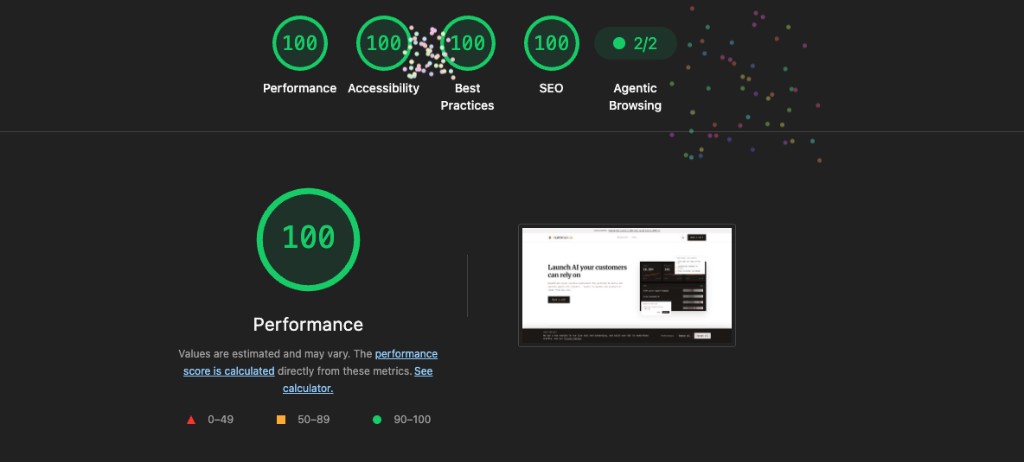
"Perfect" is a loaded word for a website, so let us be precise about this: it does not mean perfect design, which is a matter of taste. It does not mean perfect conversion, which is a matter of your funnel and your market. It means perfectly built: a set of properties a machine can now grade in seconds. That shift, from opinion to audit, is the whole story.
Four audits, one discipline
For years these were four separate specialisms, usually owned by four separate teams who quietly disagreed about which mattered most. Getting all four into the green was a project measured in weeks, sometimes months and a perfect sweep of 100s was almost unheard of for a small or mid-sized team. And as we all know, design was usually the one asked to give something up in the heat of a looming deadline. I have watched a layout that looked right in Figma arrive in the browser subtly off, type rendering lighter and spacing drifting; been sent back at launch week to redraw components after an audit flagged contrast the comps never measured; and seen a clean page put on weight with every script marketing bolted onto it until the performance score went unapologetically red. Accessibility was a retrofit, performance was someone else's budget to defend, and SEO hygiene was a forgotten ticket. Four bills, four owners, and design caught in between.
In 2026 the impossible task of building a perfectly scoring website became reality. Frontier LLMs now promptly produce clean, semantic, stable HTML that renders on the server, with almost no third-party script and no heavy framework shipped to the browser. They also give non-engineers a way to bypass page-builders that quietly bolt websites with a payload of scripts: the tools that looked cleanest while building were often the ones that shipped the most weight once published.
Nowadays a <button> that is genuinely a button serves a mouse user, a keyboard user, a screen reader, Google's crawler and an AI agent reading the accessibility tree. One decision, five audiences. That pattern is now everywhere. Descriptive link text is an accessibility fix, a search signal and an agent-navigation cue at once. A layout that does not shift as it loads passes Core Web Vitals, helps a screen reader follow the page and stops an agent clicking the wrong thing.
Build quality used to be four bills. Now it is one. And the work that used to swallow those weeks is now work a machine can speed up tremendously. The floor has come up, and it has come up fast.
Why this is becoming a standard
One aspect that changed is not the craft. It is the cost of skipping it, which has moved from soft to hard. Three forces, on three different clocks.
Legal, and already here. The European Accessibility Act became enforceable on 28 June 2025, holding services sold into the EU to WCAG 2.1 AA. It has teeth: a French court ordered Carrefour to reach full conformance or face daily fines, and Germany's transposition allows fines up to 100,000 euros plus warning letters from competitors. In the US, more than 8,600 ADA web accessibility lawsuits were filed in 2025. For an inaccessible checkout, "we will fix it later" now has a number attached.
Competitive, and measurable. Core Web Vitals are a confirmed Google ranking signal, though a modest one. They work as a gate and a tie-breaker: passing the "Good" thresholds keeps you in the race, and between two comparable pages the faster one tends to win. The larger effect is on revenue, where slower pages simply convert worse.
Discovery, and emerging. In May 2026 Google added an experimental Agentic Browsing category to Lighthouse, grading whether an AI agent can actually read and use your site. Agents skip what they cannot parse. As assistants start doing the browsing on someone's behalf, a site an agent cannot understand is a site that quietly drops out of the answer.
The honest asterisks
It would be easy to oversell this, so here are the caveats we hold ourselves to.
A Lighthouse 100 is a lab score. Google ranks on field data from real Chrome users, not the number in the tool, so a perfect audit is strong evidence of a fast site, not a guaranteed fast experience for someone using an old phone on a train. Past the "Good" threshold, ranking returns flatten quickly, and content and relevance still do the heavy lifting. The Agentic Browsing category is explicitly experimental and does not feed search rankings at all.
The checklist itself is not above reproach, and the clearest proof is a check we skip on purpose. The Agentic Browsing category looks for an llms.txt, a summary of your site written for AI systems. We do not publish one. A missing file is marked Not Applicable rather than a failure, so it costs the score nothing to leave off, and next to nothing to add: a few lines of Markdown that would flip the audit to a pass. We still don't, because taking a free point for a file nothing reads is gaming the checklist, not building well. Google Search ignores llms.txt outright, Google's John Mueller calls it purely speculative, and independent server logs show roughly 97% of these files never get a single AI-bot request. We would rather sit at 2 out of 2 honestly than add a point for a file Google's own search team says it does not read. A score tells you whether you ticked the boxes. It cannot tell you the boxes were the right ones.
How we did it
The build itself is unglamorous, which is the point. Clean, semantic HTML based on our design system, a decent part is AI-generated, iterated through Figma and Cursor and then reviewed by the team, with no heavy framework shipped to the browser. A self-hosted consent script instead of a third-party tag manager, so nothing loads before you say yes. Chat and embedded product demos load only on intent, not on arrival. Minimal, deferred JavaScript and no render-blocking third parties. Accessibility built in rather than retrofitted (enforced through a SKILL): real semantic elements, descriptive links, keyboard-safe menus, checked contrast. The usual hygiene underneath, canonical URLs, a sitemap, structured data and a real 404 page.
None of it is exotic. It is mostly the discipline of not adding weight you cannot justify. The same instinct that keeps an agent working once it leaves the demo is the one that keeps a site working for real users, real crawlers and real agents. A company selling AI you can rely on shipping a site that agents can actually read is the proof, not the pitch.
When everyone can hit 100%
Here is the uncomfortable part, and the reason this is not a victory lap. If the work behind those four green rings is mostly mechanical, a machine can do it. A perfect audit is becoming something you buy rather than something you earn over a quarter. We know, because we built the site that way, with AI doing much of the build work. Yes we used a custom combination of SKILLs, worked on our prompts and made the final decisions, but let's be honest, most tech professionals can do this as well, and increasingly, they will.
A score stops being a differentiator the moment it stops being hard. 100% is turning into table stakes: the price of being in the room, not the thing that wins it. It is going the way of HTTPS and a mobile layout, the kind of thing you only notice by its absence. When everyone clears the bar, the bar no longer tells you who is better.
So the interesting measurement moves up a floor. A machine can grade the build, it cannot grade the idea. What is left, once the checklist is cheap, is the part no linter scores: the quality of the thinking, the restraint, the taste. Is the design a point of view or a template? Does the page say something true, and say it well? Did someone decide what to leave out?
What it means for everyone else
The upside is just as real. When a machine handles the boring build work, the rest of us get more time for what actually matters, to ourselves and to the businesses we work for. Instead of losing a day to a shifting layout, we can wrap our heads around the tagline that truly resonates, craft an animation that makes someone smile, or gather the feedback that moves the needle. More time with our customers than our computers.
None of this is licence to skip the build; the bill for ignoring it still comes due. But passing the audit was never the achievement. "Perfect" was always the wrong word, because the score is a floor you keep earning, and everything above it, the idea, the judgment, the taste, is still up to you.
Hugo Campanella
Design Lead, Rightbrain
Hugo Campanella is Design Lead at Rightbrain.
Run agents on a real runtime
Get in touch and see the tracing, replay, and resilience that make agents production-ready.