Tasks: one job, done the same way every time
Give every AI step a defined job, its own model and a typed result that fits the systems you already use.
 Florian RuspiHead of Growth, Rightbrain
Hand an agent a request and it will find a route through. Hand it the same request tomorrow and it may choose to execute it differently. Tasks bring determinism where deviation from the set path could cause issues downstream. Each Task does one defined job, with its own prompt, its own model and a typed result.
Why do Tasks matter?
For anyone building with agents, Tasks matter for three practical reasons.
Tasks improve the reliability of AI agents
An agent's flexibility is the reason it can handle a messy request, and the reason its results can drift. A Task narrows the job to one purpose, one set of instructions and one expected result, so the steps that feed other systems behave the same way on every run. A fallback model can handle failures from the primary model, except timeouts. A set output format means the next system always receives what it expects. Factual accuracy still comes from grounding and checking, so Tasks pair with Collections and Evals.
Tasks make it easier to integrate into existing systems
Results arrive as typed fields, with fixed options where they fit, so they slot into the CRM, accounting package or database already in use with no parsing guesswork. A Task can also be called directly through the API with no agent involved, so an existing application can embed AI without adopting a whole agent.
Workflows broken into Tasks are easier to audit and improve
Each step becomes its own unit with its own record. Every run of a Task returns its output, token counts, timing, credits used and the revision that served it, so a surprising result points to one step instead of a whole conversation.
Improving a step is just as contained. Tasks are versioned and managed separately from the agents that use them, so one step can be updated without rebuilding the workflow around it. Two versions can run side by side with traffic split between them, which compares prompts or models on live data.
A single function with its own model
A Task is a structured AI function: a prompt with typed inputs, a chosen model and a typed output. It is stateless and versioned, so each run executes one revision with no conversation memory. The same kind of input goes in and the same shape comes out.
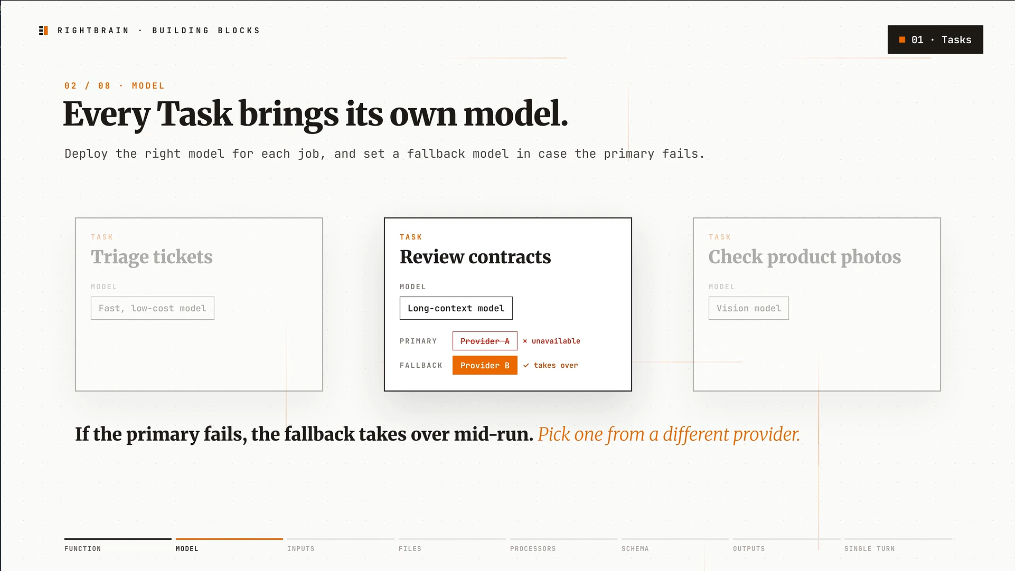
Every Task brings its own model, chosen independently of any agent that calls it. A fast, low-cost model can triage tickets, a long-context model can review contracts and a vision model can check product photos. Set a fallback model to use if the primary model fails. Timeouts do not trigger fallback. An agent on a frontier model can hand classification to a smaller, faster model through a Task, so each step gets the right model for the job.
Inputs in, schema out
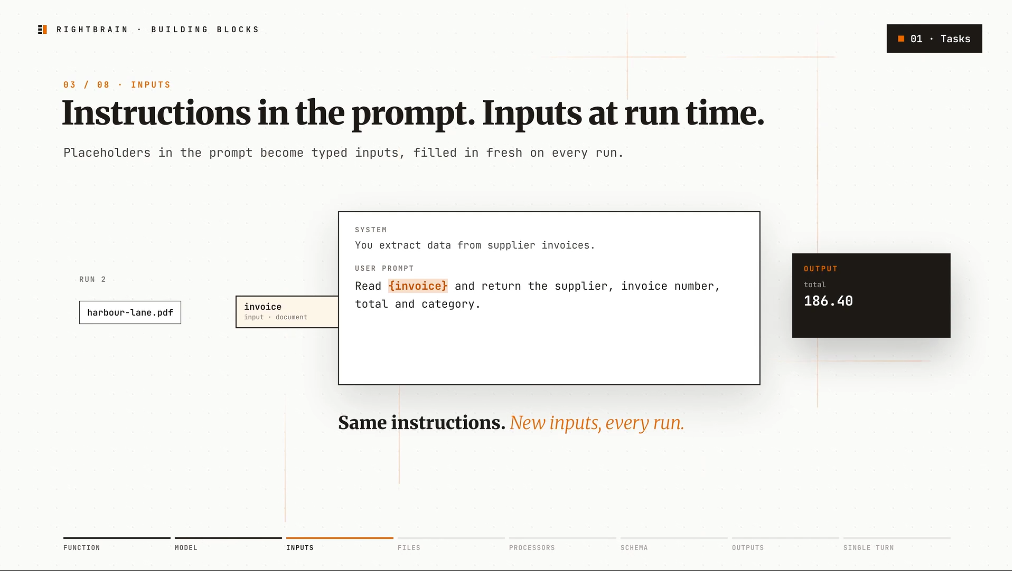
Instructions sit in the prompt, and placeholders become typed inputs filled in fresh on every run. File-capable models read images and PDFs directly. Input processors prepare the rest, turning a URL, a document, an audio file or a search query into text before the prompt is rendered.
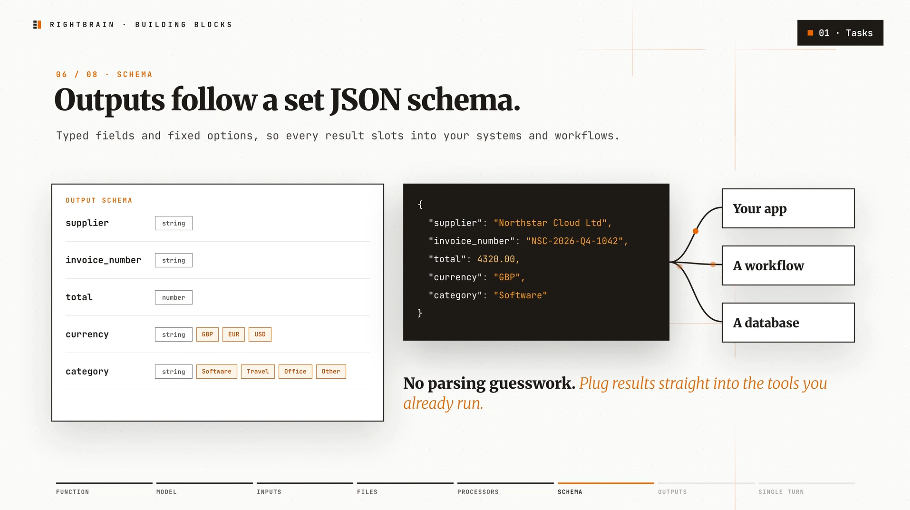
Outputs follow a set JSON schema, with typed fields and fixed options: a currency limited to GBP, EUR or USD, a category limited to Software, Travel, Office or Other. Each result slots into the systems and workflows already running, with no parsing guesswork. JSON is one of six output types, alongside text, image, audio, PDF and CSV. File outputs are stored on the run with download URLs.
How agents use Tasks
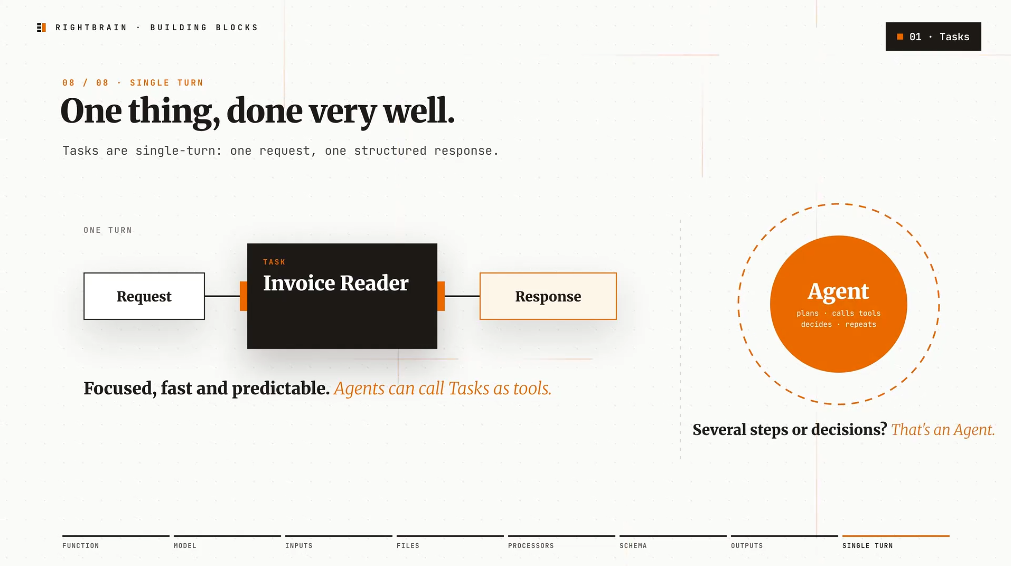
Make a Task available to an agent and it becomes a tool the agent can choose to call. Tasks are managed and versioned separately from any agent using them, so a step can be updated on its own.
The division of labour is clean. The agent plans and decides. Each Task does one thing, very well, run after run. When a job is a single specialised operation with reliable structured output, call the Task directly and skip the agent altogether. When the work needs several steps or decisions, an agent orchestrates and Tasks become its tools.
Full detail on how Tasks are built and versioned: Tasks docs.
Florian Ruspi
Head of Growth, Rightbrain
Florian Ruspi is Head of Growth at Rightbrain.
Run agents on a real runtime
Get in touch and see the tracing, replay, and resilience that make agents production-ready.